Silver-graphite plating is a silver plating in which graphite is co-deposited within the silver plating coating.
When subjected to sliding friction, the graphite crushes and spreads over the surface, providing lubricity.
Hard silver plating is a silver plating with a hard coating. While the hardness of general pure silver plating is 50 to 80 Hv, hard silver plating is considerably harder at 180 to 200 Hv.
Its hardness makes it resistant to wear, and it is said to be suitable for plating on sliding parts.
Although both are said to be suitable for plating on sliding components, we compared which one is superior in terms of sliding performance.
The sample substrate used was a copper plate (100 × 67 × t0.3 mm, Hull cell copper plate).
Samples were prepared with varying plating thicknesses of 5, 10, and 30 μm for each type and used for testing.
Results of the Sliding Test
The test was conducted under the following conditions.
Equipment used: Load-varying friction and wear tester HHS2000 (Shinto Scientific Co., Ltd.)
Constant load: 1,000 gf (9.8 N)
Travel distance: 5 mm back and forth
Movement speed: 50 mm/sec
Mating material: Cu (C1100) Φ10 ball, bright Ag plating aiming for 50-60 μm
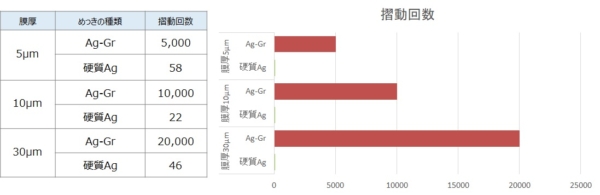
The test results are shown in the graph below.
For silver-graphite plating, the number of sliding cycles increased as the film thickness increased, with 5,000 cycles at 5 μm, 10,000 cycles at 10 μm, and 20,000 cycles at 30 μm.
On the other hand, for hard silver plating, it was only about 20 to 60 cycles for all film thicknesses.
This is because the equipment made an emergency stop due to overload.
Under the above conditions, the result showed that silver-graphite plating withstood a higher number of sliding cycles than hard silver plating.
Observation of the Sliding Area After the Test
To see what differences there were between these two types of plating, we will observe the sliding area after the test.
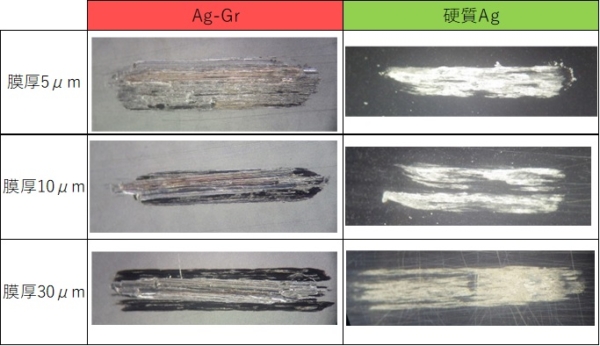
As the silver-graphite plating undergoes sliding, the copper substrate eventually becomes visible.
In contrast, the hard silver plating does not appear to have slid smoothly and looks as if it was catching or snagging.
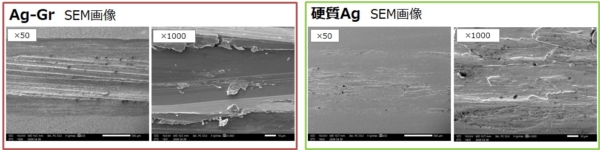
Looking at the SEM images, marks from sliding left and right can be seen on the silver-graphite plating, whereas the hard silver plating appears to be built up or swollen.
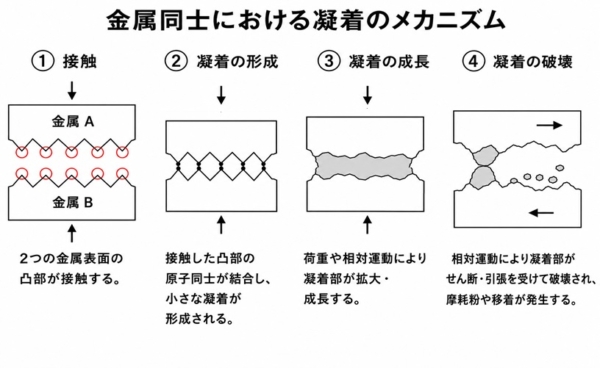
This is believed to be due to adhesion with the mating part (the copper ball with bright silver plating) it slid against.
Adhesion is a phenomenon where, when two solids come into contact or slide against each other, they fuse and stick together at the contact surface due to pressure or frictional heat.
It is more likely to occur between the same elements.
In this case, the mating part was a "copper ball with bright silver plating," and although hard silver plating contains trace amounts of other elements, it is mostly silver, making it a combination highly prone to adhesion.
In silver-graphite plating, graphite is contained in the coating. When sliding occurs, the graphite breaks apart, scatters over the surface, and gets between it and the mating part, reducing direct silver-to-silver contact. Since graphite itself has lubricating properties, it demonstrates excellent sliding performance.
When a sliding test was conducted using samples plated with silver-graphite plating and hard silver plating, it was found that silver-graphite plating withstood a higher number of sliding cycles and had superior sliding performance compared to hard silver plating.
Observing the sliding areas, the silver-graphite plating showed left and right sliding marks, whereas the hard silver plating did not appear to slide smoothly and had raised, built-up areas.
This is likely because it adhered to the mating copper ball with silver plating, causing the surface metals to stick together.
On the other hand, for silver-graphite plating, the graphite in the coating gets between the sliding metals, reducing the direct contact area while providing lubricity. This allows for smooth sliding, which is thought to be the reason for the higher number of sliding cycles.
From the above, it was found that silver-graphite plating has superior sliding performance compared to hard silver plating.
It is considered optimal as a plating for areas where metals come into contact and slide against each other.
We accept small-lot trial production for silver-graphite plating. If you have any questions, please feel free to contact us.