Electrolytic nickel-phosphorus plating is a nickel plating in which about 8 to 14 wt% of phosphorus is co-deposited.
The co-deposition rate of phosphorus can be adjusted.
The co-deposition of phosphorus makes the coating dense and hard, improving its corrosion resistance.
By applying it as an undercoat plating, it can prevent the substrate material from diffusing to the surface when heat is applied.
Additionally, it has a longer solution life than electroless nickel-phosphorus plating, allowing costs to be kept low.
Appearance of Electrolytic Nickel-Phosphorus Plating
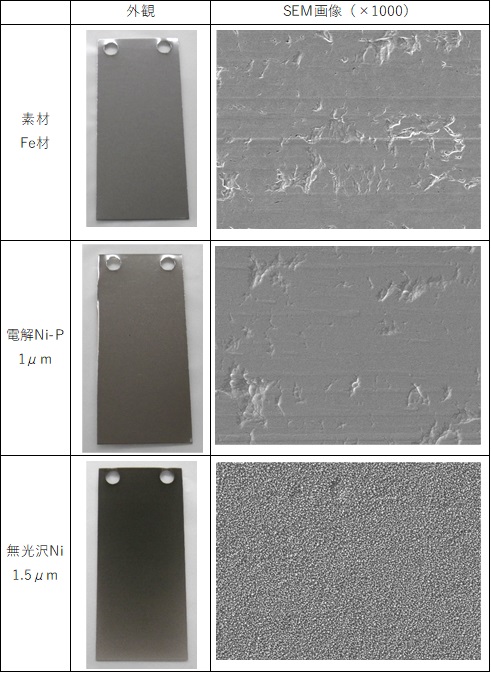
Electrolytic nickel-phosphorus plating has a glossy appearance.
Looking at an SEM image, you can see grainy particles in matte nickel plating, but such particles are not visible in electrolytic nickel-phosphorus plating.
Metal corrosion and diffusion occur along these grain boundaries.
Since electrolytic nickel-phosphorus plating lacks grain boundaries, corrosion is less likely to occur, making it highly corrosion-resistant. It also effectively prevents diffusion, which is why it is used as an undercoat plating.
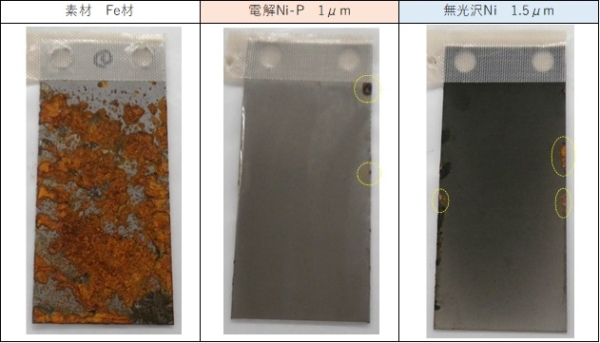
To compare corrosion resistance, a salt spray test was conducted. It is based on JIS Z2371 or H8502.
Salt spray tester: STP-30 (Suga Test Instruments Co., Ltd.) / Sodium chloride concentration: 50 g/L / Temperature: 35°C / Time: 24 hours
The iron substrate material was completely rusted and corroded.
For the electrolytic nickel-phosphorus plating, rust was observed only in some areas, such as fractured surfaces and spots where saltwater likely accumulated.
In the matte nickel plating, rust was seen on multiple fractured surfaces.
Looking at the extent of the rust formation, it can be said that electrolytic nickel-phosphorus plating has better corrosion resistance than matte nickel plating.
Hardness of Electrolytic Nickel-Phosphorus Plating
One of the characteristics of electrolytic nickel-phosphorus plating is its hardness.
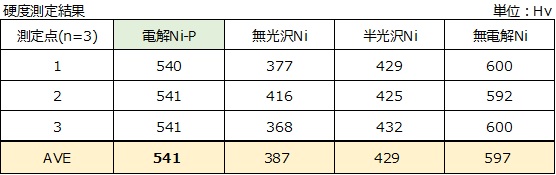
While the hardness of general matte nickel plating is around 360 to 400 Hv, the hardness of electrolytic nickel-phosphorus plating (phosphorus concentration 15 wt%) is approximately 540 Hv.
(Note: The original article references a table comparing the measured hardness of various platings.)
Measuring equipment: HMV-G Shimadzu Microhardness Tester / Measurement conditions: HV0.1 load (980.7 mN), Holding time 10 sec.
Additionally, with general electrolytic plating, applying heat causes the particles to move, which reduces the stress in the coating and lowers its hardness.
On the other hand, electrolytic nickel-phosphorus plating becomes harder when heated. This phenomenon also occurs in electroless nickel plating.
The coating hardens because the nickel and phosphorus, which were in an amorphous structure, crystallize.
When an electrolytic nickel-phosphorus plating sample was heated at 200°C for 2 hours, its hardness increased to about 590 Hv. When heated at 400°C for 2 minutes, it hardened to about 1000 Hv.
However, caution is required because if it becomes too hard, it becomes brittle. If the coating is excessively hard, cracks may form or it may peel off during bending processes.
Differences from Electroless Nickel-Phosphorus Plating and Cost
To briefly explain the difference between electroless and electrolytic plating, it lies in how the nickel-phosphorus is deposited.
While nickel is deposited through a chemical reaction in electroless plating, it is deposited by passing an electric current in electrolytic plating.
In electroless plating, the chemical reaction occurs within the solution, meaning the composition of the solution's components and its pH are constantly fluctuating. Although replenishment and adjustments are made as needed, impurities gradually accumulate. Once the nickel reaches a certain deposition amount, the entire solution must be replaced.
On the other hand, in electrolytic plating, while there are also fluctuations in composition and pH requiring replenishment and adjustment, proper solution management allows it to be used for a considerably long period.
Furthermore, electroless plating requires a high solution temperature of 90°C. Therefore, specialized tanks and equipment are necessary. Electrolytic plating, however, can be performed using the same equipment and temperature as matte nickel plating, meaning no special equipment is needed. Equipment introduction costs and utility costs can therefore be kept low.
Because of these factors, electrolytic nickel-phosphorus plating can be operated at a lower cost compared to electroless nickel plating.
We have introduced electrolytic nickel-phosphorus plating.
Electrolytic nickel-phosphorus plating features a coating that is denser and harder than general nickel plating.
From the results of the salt spray test, we found that its corrosion resistance is also excellent.
By applying it as an undercoat, it can prevent the substrate from diffusing to the surface when heat is applied.
Moreover, since it has a longer solution life than electroless nickel-phosphorus plating and requires only simple equipment, introduction and management costs can be kept low.
We accept small-lot trial production for electrolytic nickel-phosphorus plating. If you have any questions, please feel free to contact us.