Electroless silver plating forms a uniform silver coating on copper without an external power supply. It is suitable for complex shapes and parts that are difficult to connect electrically for electroplating.
Appearance and coating structure
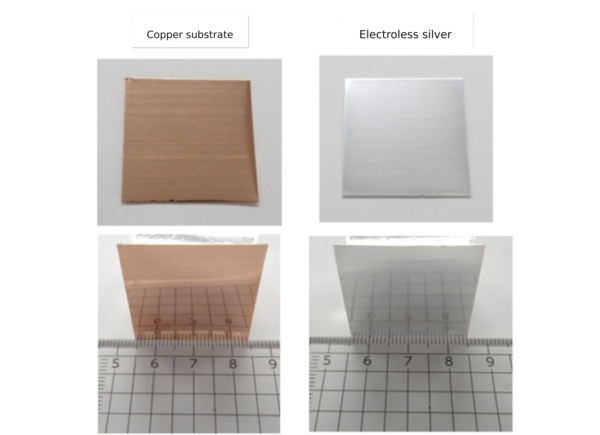
The coating has an attractive silver-white appearance. Although the process does not inherently produce a bright finish, it retains much of the copper substrate’s original luster.
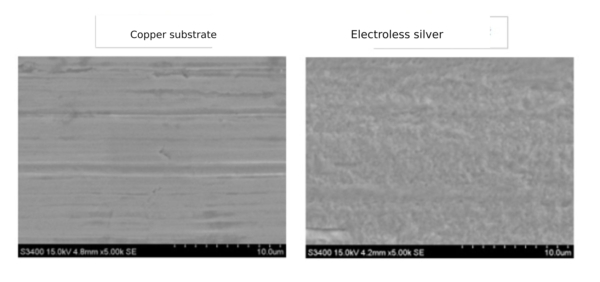
The SEM images show a dense structure of fine particles. Gentle dissolution of the copper surface during plating helps preserve the substrate’s luster.
Our electroless silver process uses displacement plating and produces a coating approximately 0.2–1.0 μm thick. The acidic bath is compatible with the resist masking used in this process, allowing masked parts to be plated without damaging the resist.
Electroplating and electroless plating
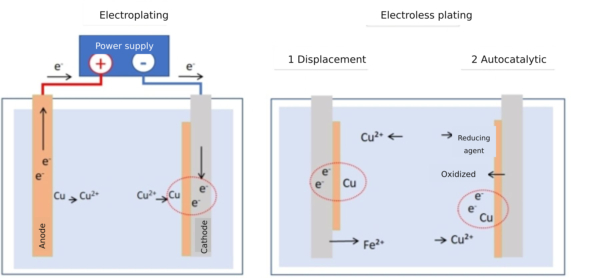
Electroplating uses an external power supply to drive metal deposition. The workpiece is connected to the negative terminal as the cathode, while the plating metal or an insoluble metal plate is connected to the positive terminal as the anode. This requires electrical contact with the workpiece.
Electroless plating deposits metal without an external electric current. There are two main mechanisms, distinguished by the source of the electrons used to reduce dissolved metal ions into a solid metal coating.
Displacement plating
When a suitable metal substrate is immersed in the plating bath, the substrate surface dissolves and releases electrons. Metal ions in the bath accept these electrons, are reduced, and deposit on the substrate.
Autocatalytic electroless plating
A reducing agent in the bath is oxidized at the catalytic metal surface and releases electrons. Metal ions accept these electrons, are reduced, and deposit as a coating. The deposited metal catalyzes the reaction, allowing deposition to continue.
Advantages of electroless plating
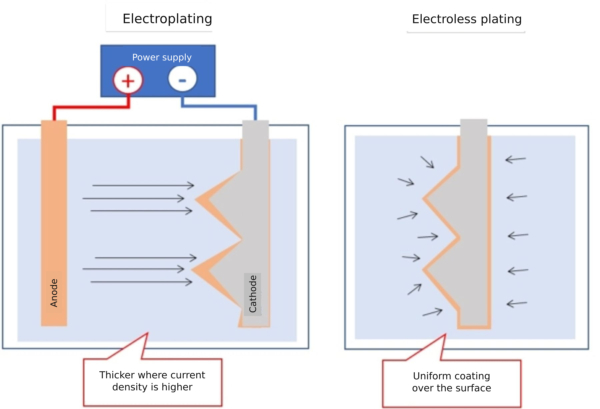
In electroplating, current density varies across a complex surface. Areas receiving more current tend to develop thicker coatings, making uniform thickness difficult to achieve.
Electroless plating relies on chemical reactions at the surface rather than an externally supplied current. This allows more uniform coatings on complex shapes. It also eliminates the need for electrical contact, making it useful for intricate circuits, exposed metal areas on resin parts, and very small metal components.
Electroplating allows the deposition rate to be adjusted by changing the current. Under fixed bath conditions, the deposition rate of electroless plating is relatively steady and cannot be increased simply by raising the current.
Autocatalytic plating can build thicker coatings while the required reactants remain available. In displacement plating, the reaction largely stops once the substrate is covered, making thick coatings difficult to obtain.
• Uniform silver coatings on complex shapes and parts that are difficult to connect electrically.
• A fine-grained coating that preserves the substrate’s luster.
• A coating thickness of approximately 0.2–1.0 μm.
We accept electroless silver plating orders from small prototype quantities. Please contact us with any questions or to discuss your application.