Silver plating is known to soften over time.
Immediately after plating, small silver crystals are densely packed in an irregular arrangement. Recrystallization is thought to progress over time, leading to changes in hardness.
We wanted to see for ourselves how much the hardness of our silver plating decreases and whether the current density used during plating makes a difference. We therefore measured the hardness over time.
Sample 1: Silver plated on a copper Hull cell panel at 0.3 A/dm².
Sample 2: Silver plated on a copper Hull cell panel at 1.0 A/dm².
Both samples had a plating thickness of 15 μm.
Hardness Tester and Test Conditions
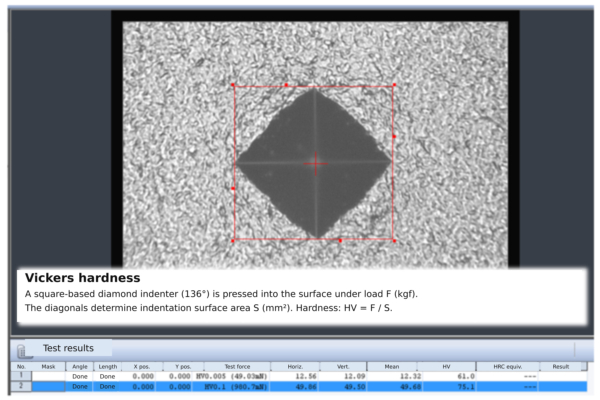
Micro Vickers hardness tester: HMV-G21DT (Shimadzu).
Test load: HV0.005 (49.03 mN).
Dwell time: 10 seconds.
Number of Measurements and Measurement Frequency
Hardness was measured at three selected locations on each sample, and the mean value was calculated. Measurements were taken around noon every weekday.
Hardness Measurement Results
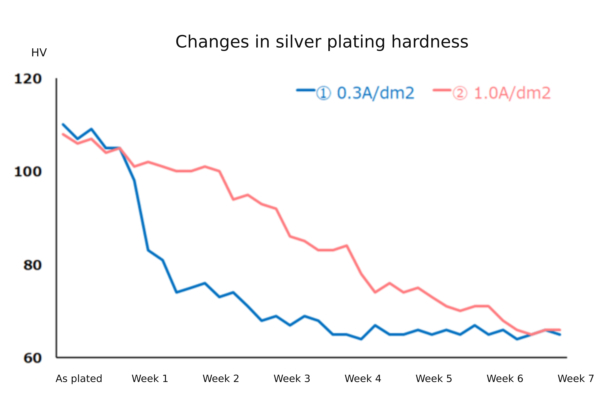
Immediately after plating, both samples had a hardness of approximately 110 HV. The hardness of the sample plated at the higher current density (Sample 2) decreased gradually, while that of the sample plated at the lower current density (Sample 1) decreased rapidly.
This may indicate that the denser silver deposit produced at the lower current density is more susceptible to recrystallization, resulting in a more pronounced decrease in hardness.
The hardness of both samples eventually stabilized at approximately 65 HV.
We are also interested in whether brightness and the presence or absence of additives affect hardness, and we hope to investigate these factors when the opportunity arises.