Strike plating is a very thin layer deposited before the main plating layer to improve adhesion between the substrate and the coating.
In this article, we introduce three types of strike plating: nickel strike, copper strike, and silver strike.
Nickel strike plating is used on substrates that readily form an oxide film, such as stainless steel, or on oxidized surfaces that are difficult to plate. The very low pH of the bath allows the substrate to be activated while nickel is deposited, improving adhesion.
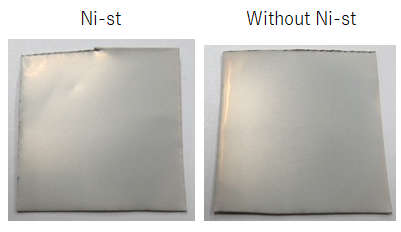
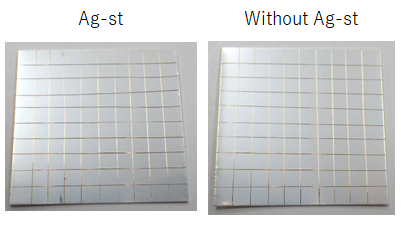
The images below show nickel plating on stainless steel. The sample on the left received a nickel strike, while the sample on the right did not. There is no noticeable difference in appearance.
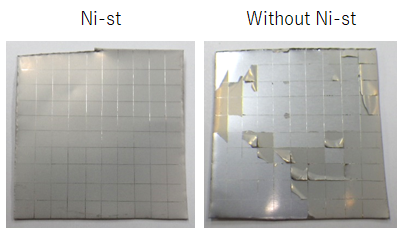
To evaluate adhesion, we performed a cross-cut tape test (JIS H 8504). A grid pattern was cut into the sample surface with a cutter, and adhesive tape was applied and then removed.
The nickel coating on the sample without a strike peeled off extensively.
The results show that nickel strike plating greatly improves adhesion.
Copper strike plating is used before copper plating on base metals such as iron and aluminum.
When a base metal is immersed in a copper plating bath, differences in electrochemical reactivity can cause the substrate to dissolve and copper to deposit by displacement. Copper deposited in this way has poor adhesion and can lead to peeling and blistering.
Strike baths are formulated to suppress displacement deposition, allowing copper to be plated onto base metals. Covering the substrate with a copper strike also helps protect it from dissolution in strongly acidic or strongly alkaline plating baths used in subsequent processes.
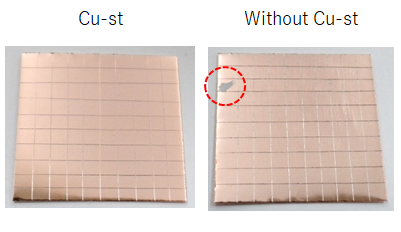
The images below show copper plating on iron. The sample on the left received a copper strike, while the sample on the right did not. Although it is difficult to see in the image, the sample without a strike has an uneven surface appearance.
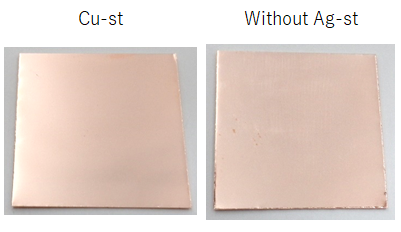
We also performed a cross-cut tape test on these samples. Some of the coating peeled off on the sample without a copper strike.
These results show that a copper strike enables subsequent plating to adhere well even to a base metal such as iron.
Silver strike plating serves a similar purpose to copper strike plating. Silver can deposit by displacement not only on base metals but also on copper.
To prevent this, the substrate is immersed in the silver strike bath with the current already applied. This suppresses displacement deposition and forms a thin, dense silver layer that improves adhesion.
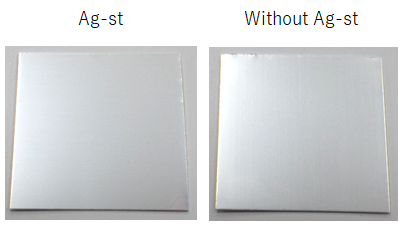
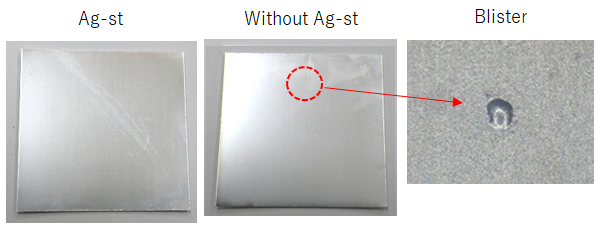
The images below show silver plating on copper. The sample on the left received a silver strike, while the sample on the right did not. There is no noticeable difference in appearance.
We then performed a cross-cut tape test.
Neither sample showed peeling in the cross-cut tape test. This raised the question of whether adhesion was sufficient without a silver strike and whether the strike could be omitted.
We therefore performed a heat resistance test, which can reveal blistering in areas with poor adhesion.
Small blisters were observed on the sample without a silver strike. No blisters were observed on the sample with a strike. The silver strike therefore provided better adhesion.
In this article, we introduced commonly used nickel, copper, and silver strikes. Strike plating is also used with other plating metals.
The properties and electrochemical reactivity of a substrate can make it difficult to obtain good adhesion with the main plating process alone. Applying a suitable strike layer helps the coating adhere to the substrate.