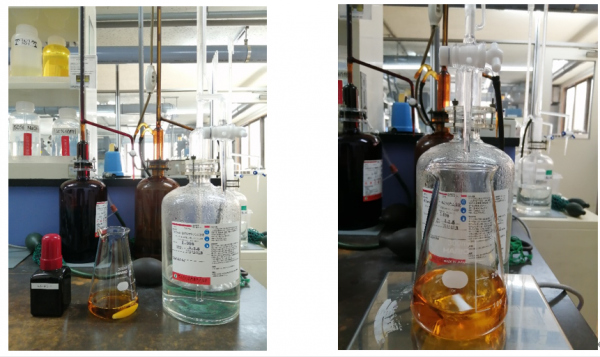
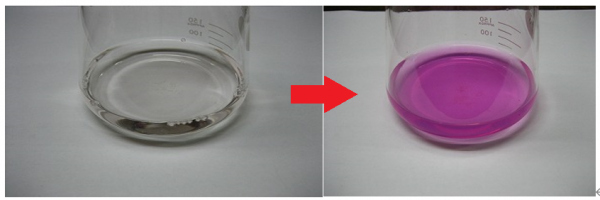
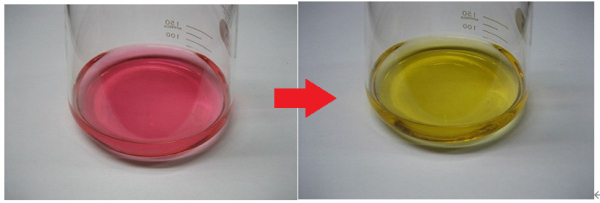
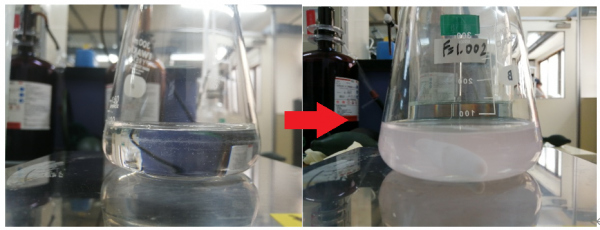
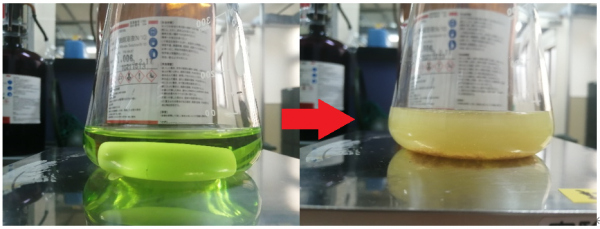
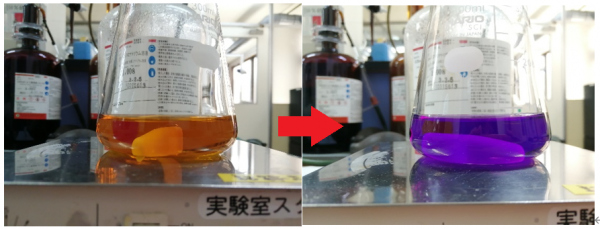
Titration determines the concentration of a substance in a solution by reacting it with a reagent of known concentration. An indicator is commonly added, and its color change is used to identify the endpoint.
The concentration is calculated by multiplying the volume of reagent used at the endpoint by a conversion coefficient and a standardization factor.
The conversion coefficient is derived from the chemical reaction and accounts for quantities such as molecular weight, valence, and sample volume. The standardization factor corrects for the difference between the actual reagent concentration and its nominal concentration.
The titrations described here can be broadly grouped into those that identify the endpoint through pH changes and those that use other types of reactions.
Titration Based on pH Changes
Acid Base Titration
An alkaline reagent is used to titrate an acidic solution, while an acidic reagent is used to titrate an alkaline solution. In an acid–base neutralization reaction, hydrogen ions and hydroxide ions combine to form water (H₂O).
Common indicators include phenolphthalein and methyl orange. Examples of solutions analyzed using this method include detergents and sulfuric acid.
Phenolphthalein has a color transition range of approximately pH 8–10.
Methyl orange has a color transition range of approximately pH 3–4.4.
Titration Using Other Reactions
Redox Titration
The endpoint is identified when the reaction between the substance being analyzed and the titrant is complete. In some methods, excess titrant then reacts with an indicator to produce a color change.
Example: Cyanide.
Precipitation Titration
The endpoint is identified by the formation of a precipitate. In some methods, once the reaction between the analyte and the titrant is complete, excess titrant reacts with an indicator to form a precipitate.
Example: Nickel chloride.
Chelatometric Titration
Chelating agents compete to bind metal ions. Depending on the method, pretreatment may include making the solution strongly alkaline to establish suitable conditions for the reaction.
Example: Nickel sulfate.
Although the same basic equipment is used, titration relies on different chemical reactions depending on the component being analyzed. At METEK, we perform titrations every day as an essential part of plating bath control.