Silver–graphite plating incorporates graphite particles into a silver coating by codeposition. It offers electrical conductivity comparable to pure silver plating, together with much higher wear resistance, making it well suited to connectors, plugs, and other components that undergo sliding contact.
Features of Silver Graphite Plating
Silver is known for its high electrical and thermal conductivity. These properties make it useful for plating electronic components, particularly electrical contacts such as connectors and busbars.
However, silver is a soft, ductile metal and can wear during repeated insertion, removal, or sliding. If the silver coating wears through and exposes the substrate, electrical resistance may increase and the substrate may corrode.
Codepositing graphite, a crystalline form of carbon, in the silver coating improves wear resistance. Silver–graphite plating offers much higher wear resistance than pure silver plating while retaining electrical conductivity.
Why Wear Resistance Improves
Graphite is the material used in pencil leads. It offers heat resistance, self-lubricating properties, electrical and thermal conductivity, and resistance to acids and alkalis. Its self-lubricating properties and electrical conductivity are particularly relevant here.
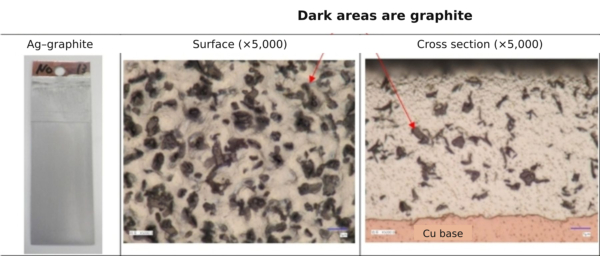
The graphite used in silver–graphite plating is a flake-shaped powder approximately 3–10 μm in size. Its presence gives the coating a matte gray appearance.
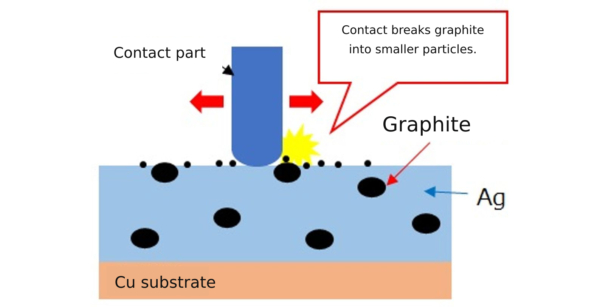
Cross-sectional observation shows graphite incorporated within the silver coating. The diagram below illustrates what happens when the coating undergoes sliding contact.
During sliding, the codeposited graphite is worn down into smaller particles. These particles spread over the coating surface and act as a lubricant, reducing friction and silver wear while helping maintain low contact resistance. Graphite itself is conductive, allowing current to pass through the contact.
Sliding Performance in Friction and Wear Tests
We compared the wear resistance of silver–graphite plating with that of matte pure silver plating using a friction and wear test.
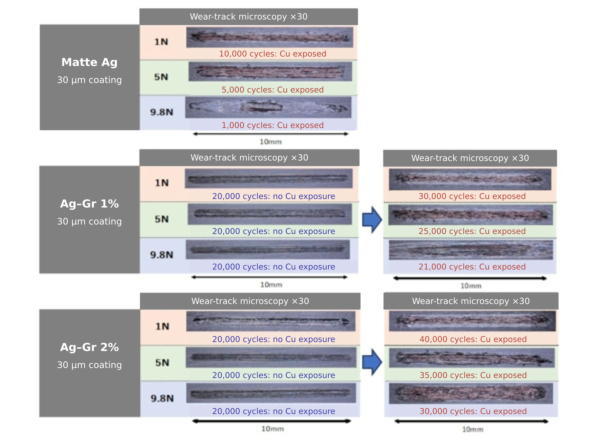
A silver-plated copper ball was moved back and forth under a constant load against a copper panel coated with either silver–graphite or matte silver. The number of cycles until the copper substrate became exposed, indicating that the silver coating had worn through, was recorded. A higher cycle count indicates better wear resistance.
Test Conditions| Parameter | Condition |
|---|
| Equipment | HHS2000 variable-load friction and wear tester
Shinto Scientific Co., Ltd. |
| Reciprocating travel | 10 mm (equipment-recommended setting) |
| Sliding speed | 10 mm/s (equipment-recommended setting) |
| Test loads | 1 N, 5 N, and 9.8 N |
| Test specimens | Copper Hull cell panels; target thickness of each silver coating: 30 μm |
| Counterbody | C1100 copper ball, 10 mm diameter; target silver plating thickness: 30 μm |
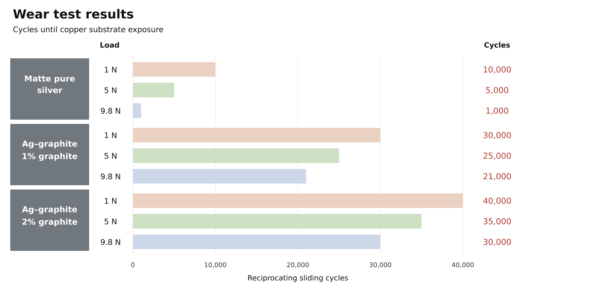
Cycles Until Copper Exposure| Coating | 1 N | 5 N | 9.8 N |
|---|
| Matte pure silver | 10,000 | 5,000 | 1,000 |
| Silver–graphite with 1% graphite | 30,000 | 25,000 | 21,000 |
| Silver–graphite with 2% graphite | 40,000 | 35,000 | 30,000 |
The results show that silver–graphite plating is much more resistant to wear than matte silver plating. A higher graphite content also produced better wear resistance.
Contact Resistance Measurements
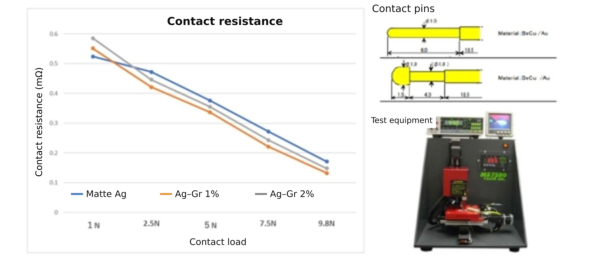
We measured and compared the contact resistance of silver–graphite plating and matte silver plating. A contact pin was pressed against a silver-plated panel under a specified load, current was applied, and the electrical resistance was measured. Higher resistance makes it harder for current to flow, while lower resistance allows current to flow more easily.
Measurement Conditions| Parameter | Condition |
|---|
| Equipment | MS7500 contact resistance tester
Fact K Co., Ltd. |
| Test mode | Single-point indentation |
| Measurement loads | 1 N, 2.5 N, 5 N, 7.5 N, and 9.8 N |
| Test specimens | Copper Hull cell panels; target thickness of each silver coating: 30 μm |
| Contact pins | 1 mm and 2 mm diameters; gold-plated beryllium copper (BeCu) |
At 1 N, silver–graphite plating had slightly higher contact resistance than matte silver plating. At loads of 2.5 N and above, silver–graphite plating had lower contact resistance.
We believe that, at lower loads, the contact pin touches graphite directly, resulting in higher resistance. At higher loads, the pin breaks down the graphite and makes direct contact with the silver, reducing resistance.
These results indicate that the presence of graphite does not present a problem for electrical conduction under the conditions evaluated.
Silver–graphite plating offers much higher wear resistance than matte silver plating, while providing electrical conductivity comparable to conventional silver plating.
These properties make it well suited to connectors, plugs, and other components that undergo sliding contact or repeated insertion and removal. Reduced silver wear may help extend component life.
We accept requests for small-scale prototype trials of silver–graphite plating. Please feel free to contact us with any questions.